
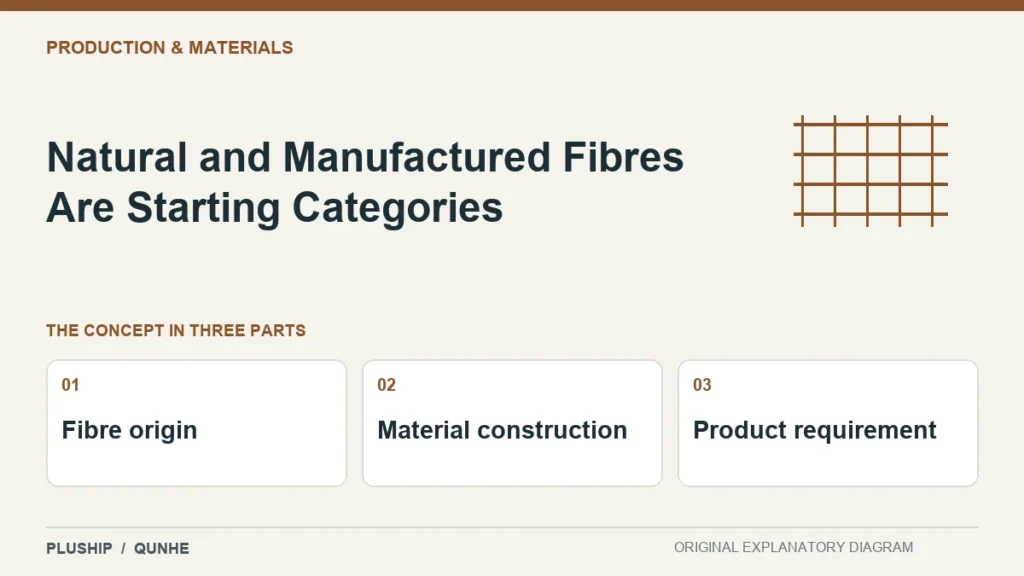
A fibre category is useful vocabulary, but it is too broad to serve as a complete material specification. Start with the category and continue to the properties the product needs.
Coats' textile-fibre guidance groups fibres by origin and describes differing fibre characteristics. Coats — Know About Textile Fibres.
Avoid the shortcut
Neither natural nor manufactured automatically means suitable for a particular plush design. Ask which material properties matter to the proposed use and which information is available for the actual material. Broad category claims do not answer those questions.
Follow the finished material
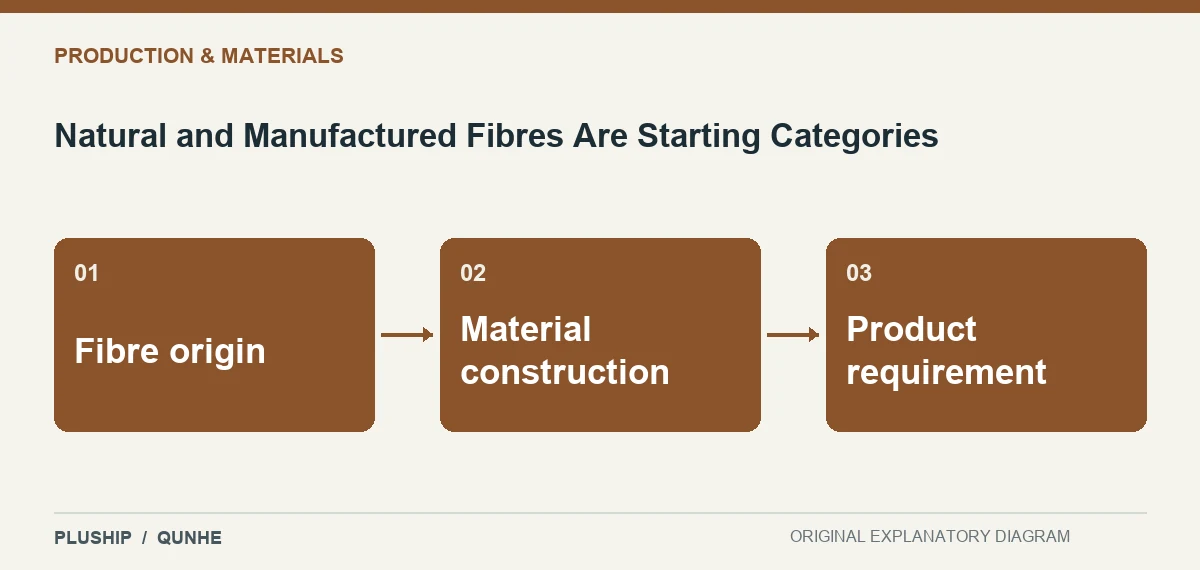
Record the relevant construction, finish and supplier identification alongside fibre information. A fibre-level description should not be presented as a measurement of the finished fabric. If the evidence applies to only one level, state that boundary.
This approach gives a designer more room to compare options fairly. It replaces a vague preference with requirements that can be discussed and evaluated for the real material combination.

Source reviewed 25 October 2026. Practical interpretation and original illustrations by PLUSHIP / Qunhe; examples are illustrative.
Related reading
A Seam and a Stitch Describe Different Parts of a Sewn Product
Lockstitch and Chainstitch Use Different Thread Formations