
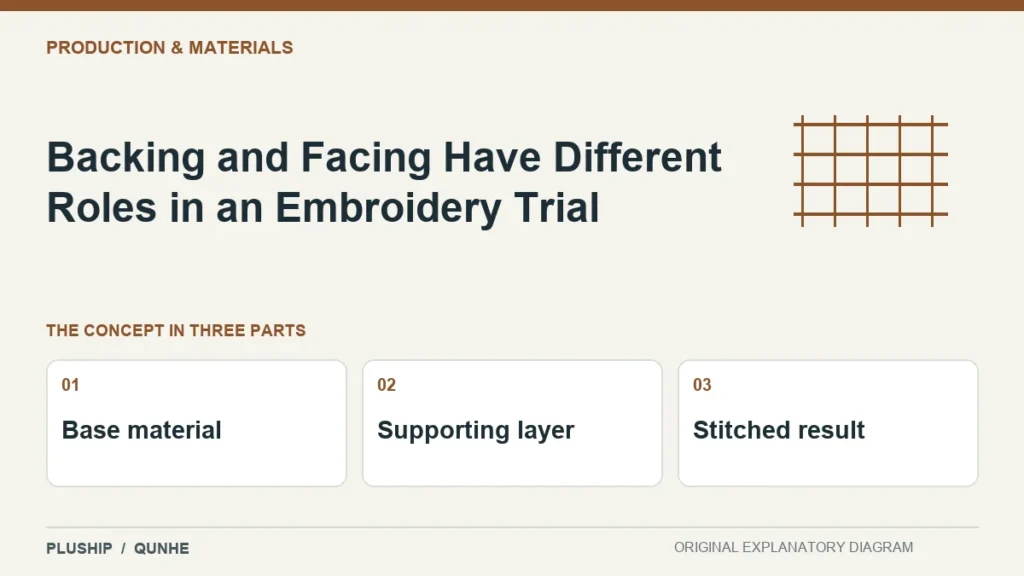
A clean embroidery result depends on more than the thread visible on the front. Supporting materials belong in the trial record when they influence the outcome.
Coats' embroidery guide includes the selection of backings and facings for different jobs. Coats — Discovering Your Embroidery Solution.
Identify the whole trial
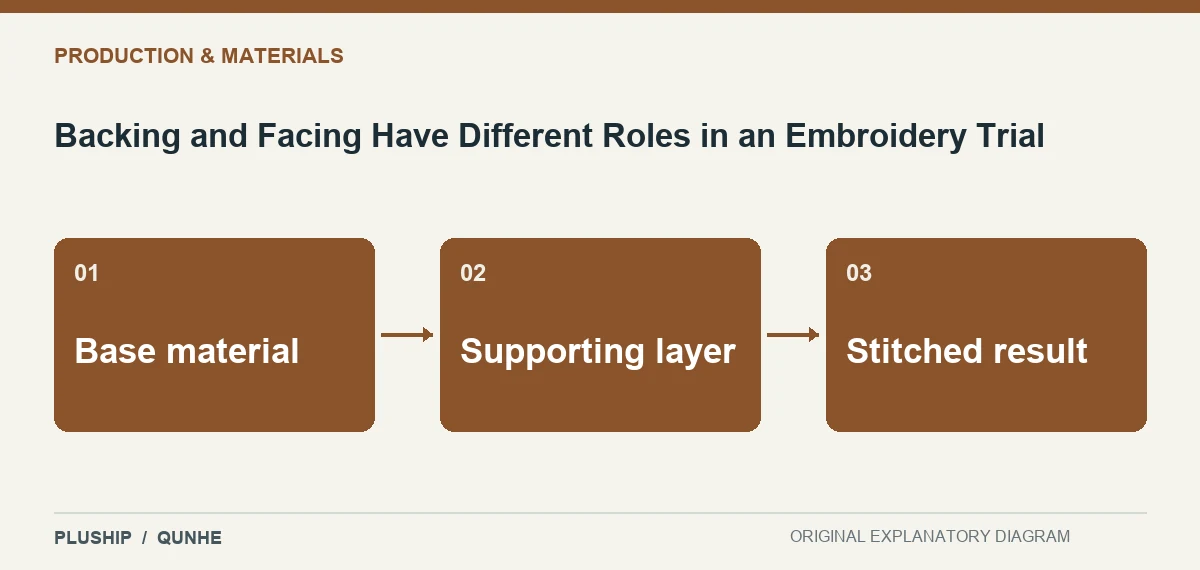
Record the base material and the supporting materials used with the stitch design. If the trial improves, the team should be able to reproduce the actual combination rather than assuming the file alone caused the change.
Inspect the intended presentation
Review the front, the relevant reverse condition and the effect on the assembled product. A supporting layer that improves one view may affect another design or handling requirement. Ask the responsible specialist to evaluate those trade-offs.
For purchasing, avoid treating the supporting layer as an invisible consumable if it is important to the approved result. Its identity and permitted substitutions need a place in the production information.
Source reviewed 25 October 2026. Practical interpretation and original illustrations by PLUSHIP / Qunhe; examples are illustrative.
Related reading
Embroidery Thread Selection Balances Appearance and Use
An Edge Finish and an Assembly Join May Have Different Jobs
Spun and Continuous-Filament Threads Have Different Construction Descriptions