
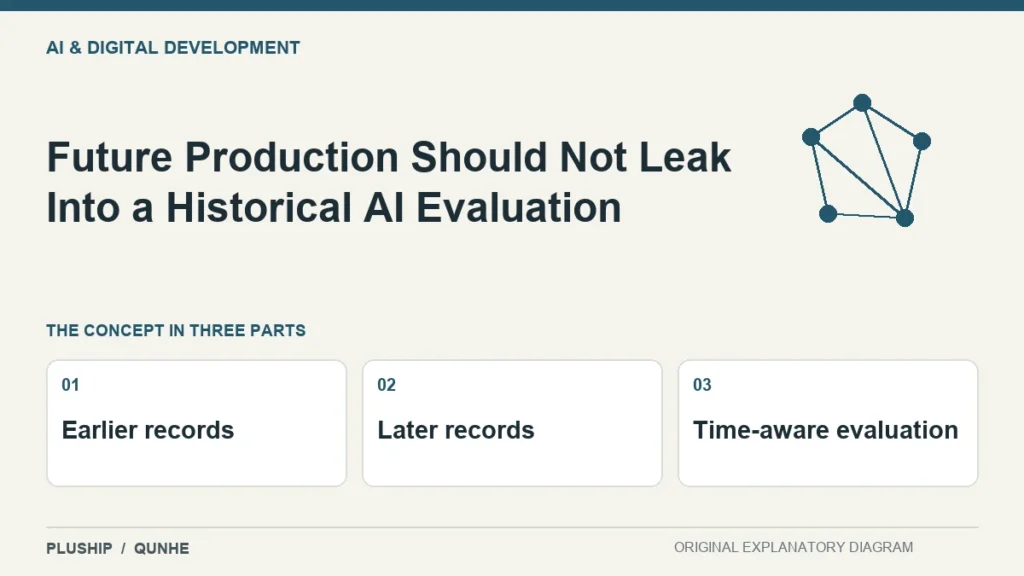
A model intended to assist future work should be evaluated without information that would only become available later. Randomly mixing a production history can hide that issue.
Scikit-learn discusses time-series splitting for evaluating data with temporal ordering. Scikit-learn — cross validation.
Reconstruct availability
For an enquiry or quality model, identify when each input would actually be known. A later disposition or complaint record cannot silently become a feature available at the earlier decision point.

Match the deployment question
Use an evaluation design suited to the timing and dependence in the data. Record gaps, repeated products and changing processes. A historical score is useful only when its information boundary resembles the intended real decision.

Source reviewed 25 October 2026. Interpretation and original diagrams: PLUSHIP / Qunhe. Examples are illustrative.
Related reading
An Unusual Image Is Not Automatically a Defective Product
Principal Components Compress Variation, Not Product Meaning
A Learning Curve Can Inform the Next AI Data-Collection Decision