

A rare pose, unfamiliar colour or new photography background can appear unusual to a model. An outlier flag needs interpretation before it becomes a product-quality label.
Scikit-learn distinguishes approaches for outlier detection and novelty detection. Scikit-learn — outlier detection.
Define the reference
State what the model considers ordinary and whether the reference data is expected to contain abnormal examples. Those assumptions influence the interpretation of a flagged image.
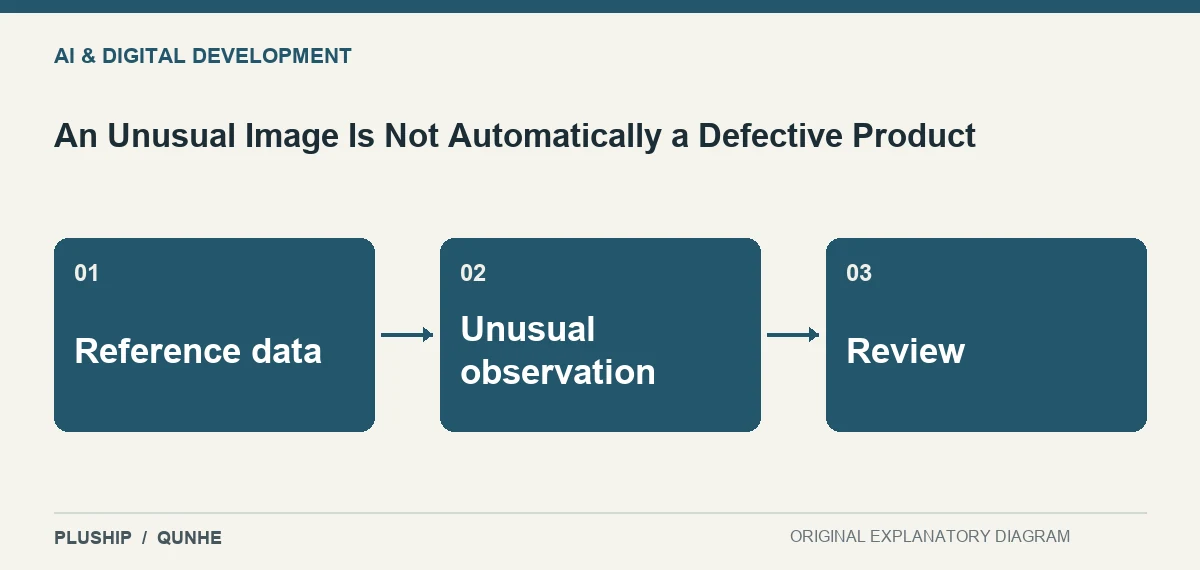
Route the finding
Review whether the flag concerns an image problem, a genuinely new design or a physical concern supported by other evidence. Do not discard a legitimate character variant because it differs from older catalogue material. The model can prioritise attention without deciding the final disposition.

Source reviewed 25 October 2026. Interpretation and original diagrams: PLUSHIP / Qunhe. Examples are illustrative.
Related reading
An Edge Detector Finds Image Transitions, Not Automatically Seams
Principal Components Compress Variation, Not Product Meaning