
A design process loses value when every test must justify continuing the original idea. Give the team a clear way to stop or redirect a concept when the evidence calls for it.
Stanford's design-thinking approach uses iterative exploration, prototyping and testing to develop understanding. Design Thinking Bootleg.
Define the decision before the test
State which finding would support further development and which unresolved issue could change the direction. Keep the criterion tied to the actual project need. Avoid adding a new justification only after the preferred concept performs poorly.
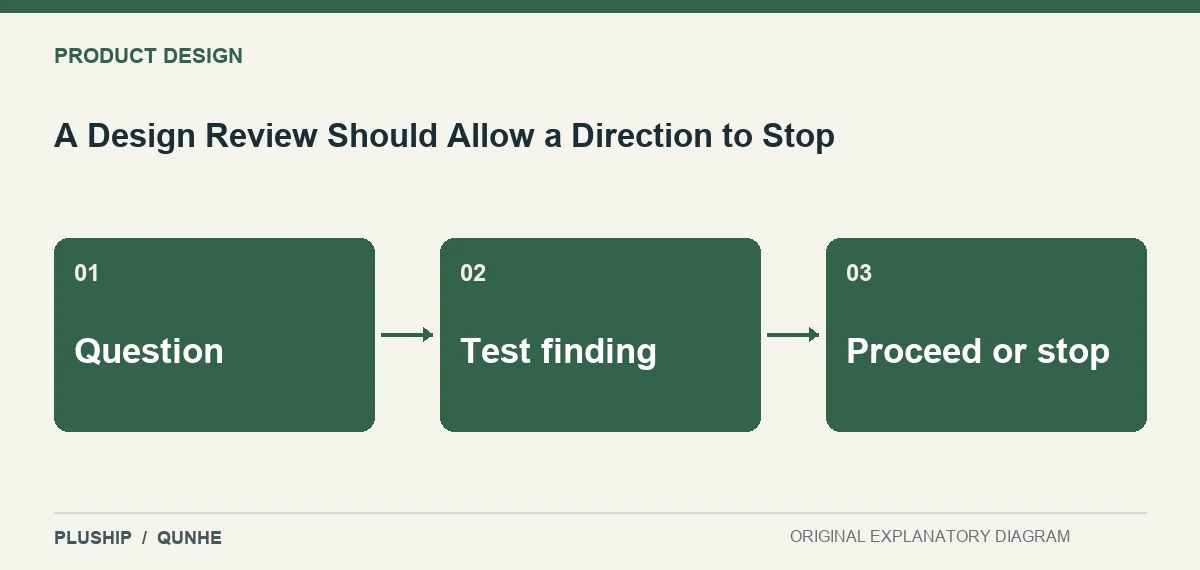
Preserve useful learning
A stopped direction may still reveal a relevant requirement or a better question. Keep that learning in the brief without carrying rejected details into the next proposal. Do not call a design accepted merely because substantial time has already been spent on it.
The useful outcome is a reasoned next step. A process that can end an unsuitable direction can protect the project's focus more effectively than one that only produces increasingly polished versions of the same unanswered idea.
Source reviewed 25 October 2026. Practical interpretation and original illustrations by PLUSHIP / Qunhe; examples are illustrative.
Related reading
Basic Expectations and Delighters Need Different Design Attention
Explore Widely and Choose Deliberately in Product Design