
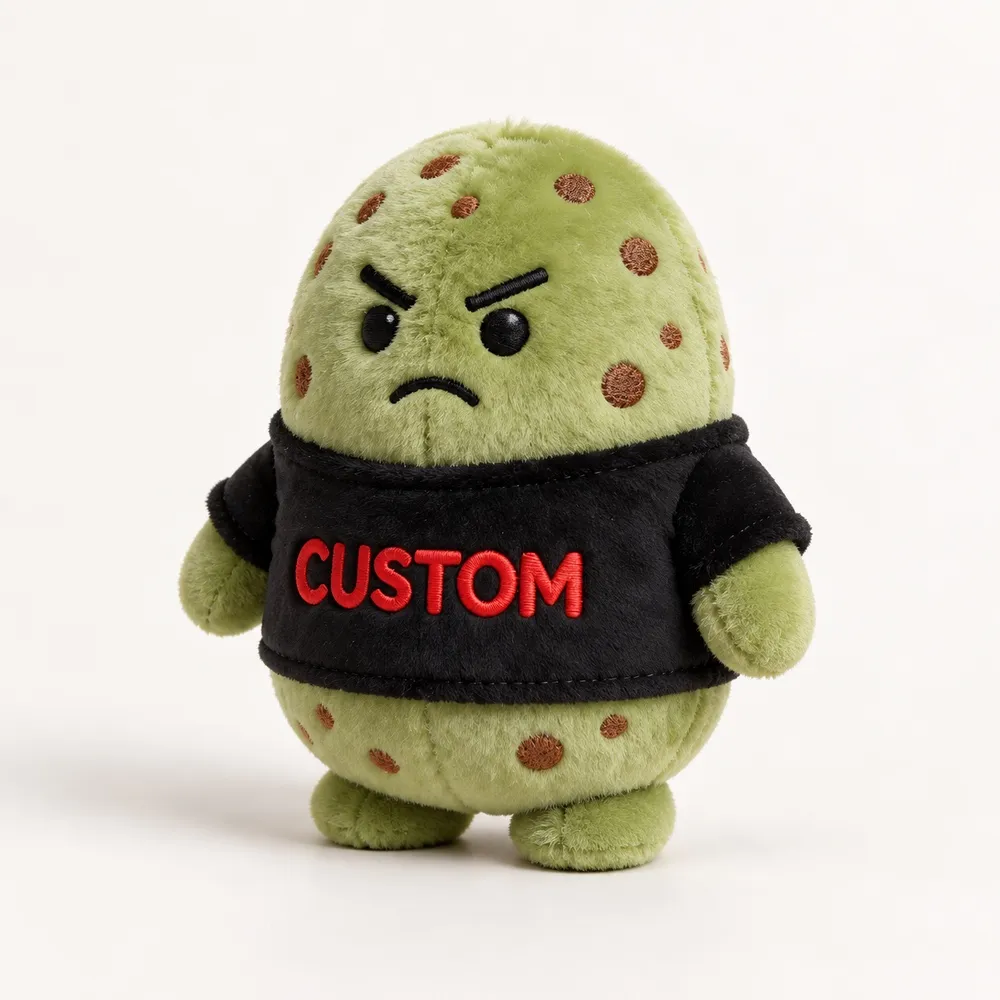
A logo drawn for a screen or printed sheet may need adaptation for plush. Start by separating the recognisable elements from the fine details, then ask the sample maker to propose how those elements could be represented at the intended size.
Keep the reference unambiguous
Provide the current artwork file and a preview that shows the correct colours and proportions. If several logo versions exist, name the required one. A character with visible lettering, such as the Lettered T-Shirt Kiwi, illustrates why wording is part of the design reference rather than a detail to leave open.
Do not describe the catalogue's lettering as an included custom-logo service. A request for different wording belongs in a separate project brief.
Identify details likely to need interpretation
Small gaps, thin lines, fine gradients and dense text can be difficult to judge in a reduced-size mock-up. Ask which details the supplier proposes to simplify, enlarge or present with a different technique. Compare the proposal with the recognition priorities before choosing.
Review at the actual intended scale
Print or display the proposed design at its intended size. Then review it on the assembled sample, where curved surfaces and joins can affect the appearance. Enlarging a photograph can help inspect an edge, but it should not be the only view used to assess readability.
Should the logo be redrawn before contacting a supplier?
Not necessarily. Send the available authorised artwork and explain the intended product. Ask what additional files or views are needed before commissioning changes that may not suit the proposed construction.
Use the 2D artwork planning guide to prepare the first conversation.