

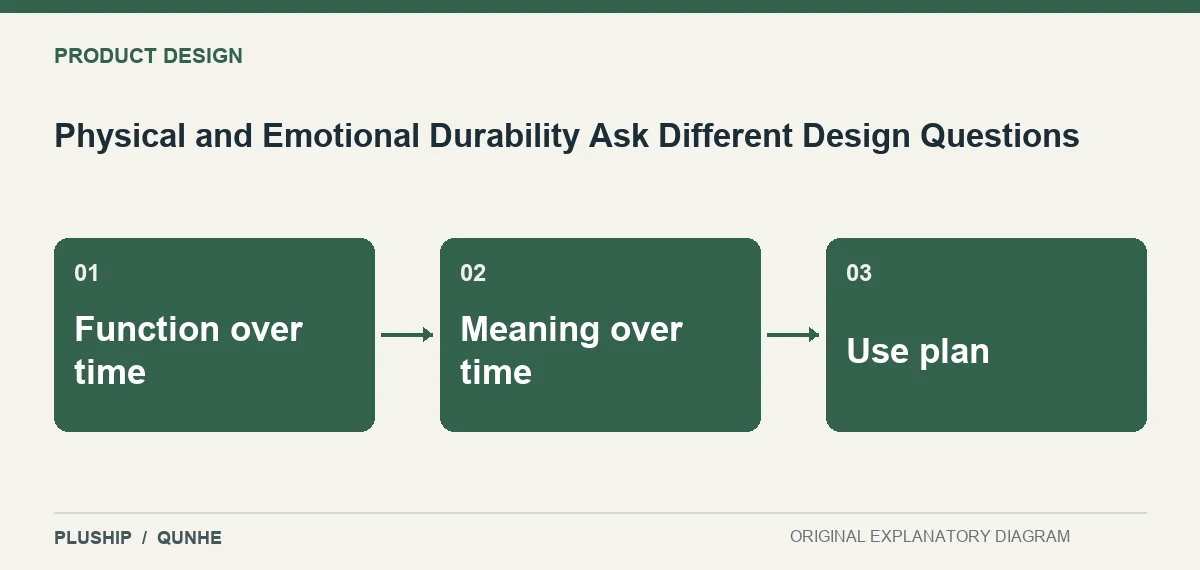
A product may remain physically intact while losing its role for the owner, or remain valued while needing repair. Consider those possibilities separately in a design brief.
The Ellen MacArthur Foundation discusses physical and emotional durability when designing products to be used more and for longer. Design products to be used more and for longer.
Define the use scenario
For an independent character product, ask which features support continued relevance and which need evidence of physical performance. A timeless-looking illustration is a design direction, not a durability test. Keep the two forms of evidence distinguishable.
Test the right assumptions
A story or ownership discussion can inform questions about meaning. Material and construction reviews address other questions. Do not use a positive response to a character's personality as proof that the physical product will last longer.
The useful outcome is a brief with clear learning needs across the product's intended life. Any claim about actual longevity still needs evidence appropriate to the finished product and its use conditions.
Source reviewed 25 October 2026. Practical interpretation and original illustrations by PLUSHIP / Qunhe; examples are illustrative.
Related reading
A Storyboard and a Physical Prototype Test Different Assumptions
Basic Expectations and Delighters Need Different Design Attention