

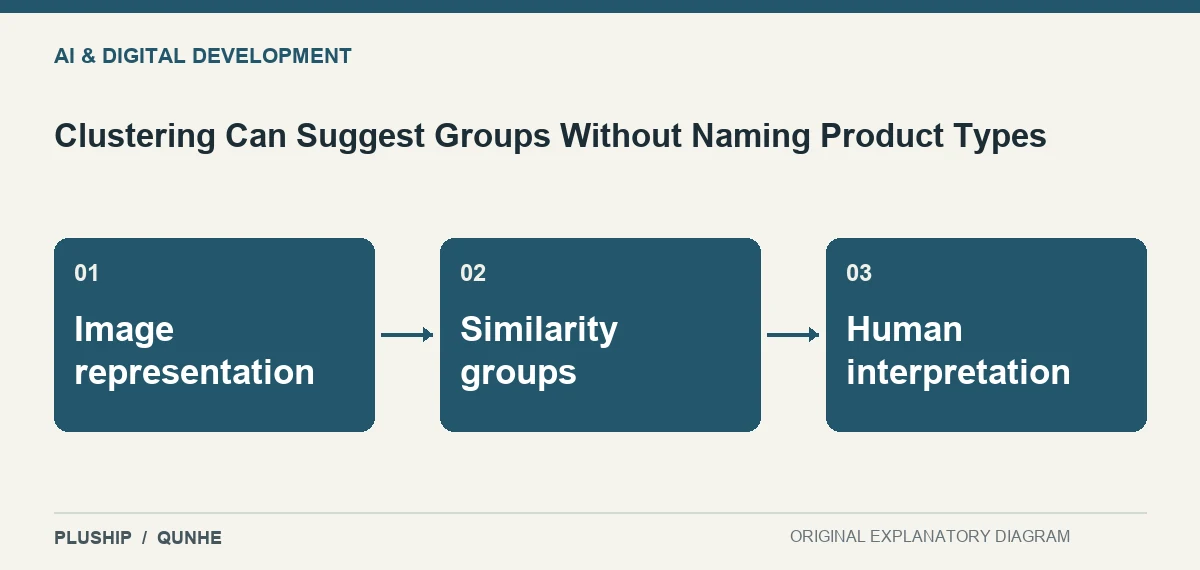
An image collection can contain repeated visual patterns without an agreed taxonomy. Clustering can help explore that structure, but it does not supply the business meaning of each group.
Scikit-learn describes clustering as grouping samples using properties of their data representation. Scikit-learn — clustering.
Inspect the representation
For a character library, a model may group by colour, background or pose rather than by product identity. Review examples within and between clusters before giving them catalogue labels.
Keep the grouping provisional
A cluster is an analytical result under a chosen method and settings. It does not prove that the items belong to one sellable product. Preserve source identities and have a product owner review the suggested organisation before changing the catalogue.

Source reviewed 25 October 2026. Interpretation and original diagrams: PLUSHIP / Qunhe. Examples are illustrative.
Related reading
An Unusual Image Is Not Automatically a Defective Product
Instance Masks Separate Individual Objects in a Product Photograph