
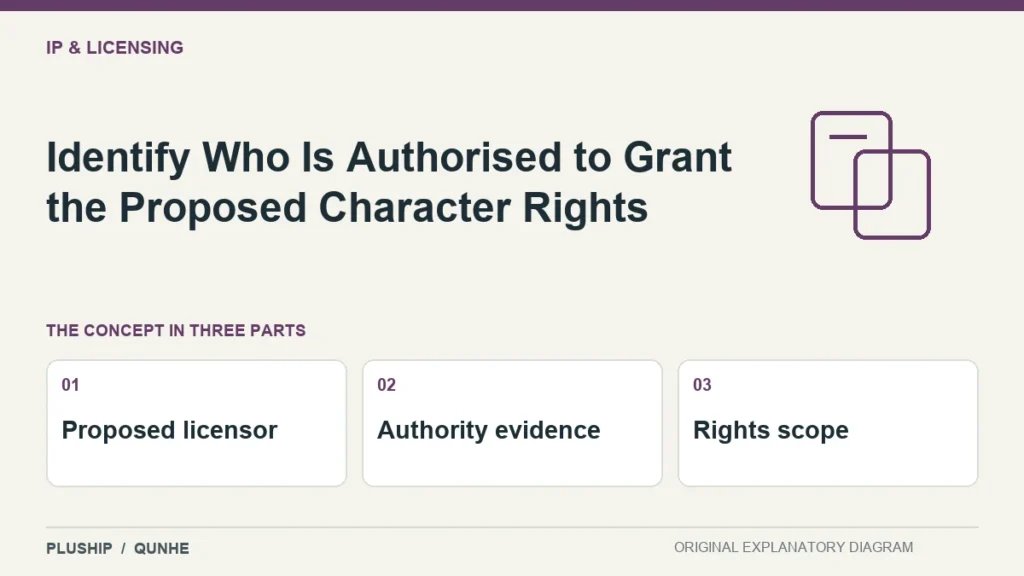
An attractive licensing presentation may come from an owner, an agent or another intermediary. The actual authority to grant the proposed rights needs its own basis.
WIPO describes licensing agreements as defining rights granted by one party to another. WIPO — Technology Transfer Agreements.
Identify the party and role
For a character proposal, record the legal party and the role claimed. A person's involvement in design discussions or appearance on a contact list does not, by itself, explain their authority for the transaction.

Resolve before commitment
Have the relevant documents and arrangements reviewed appropriately. Keep scope and authority questions open where evidence is missing. This is a due-diligence framework, not a finding about any named organisation or a substitute for review of the actual agreement.

Source reviewed 25 October 2026. Interpretation and original diagrams: PLUSHIP / Qunhe. Examples are illustrative.
Related reading
A Product Photograph and the Character in It Can Raise Different Rights Questions
Several Contributors Can Create Several Rights Questions in One Character Asset
A Free Character Giveaway Still Needs a Defined Rights Basis