

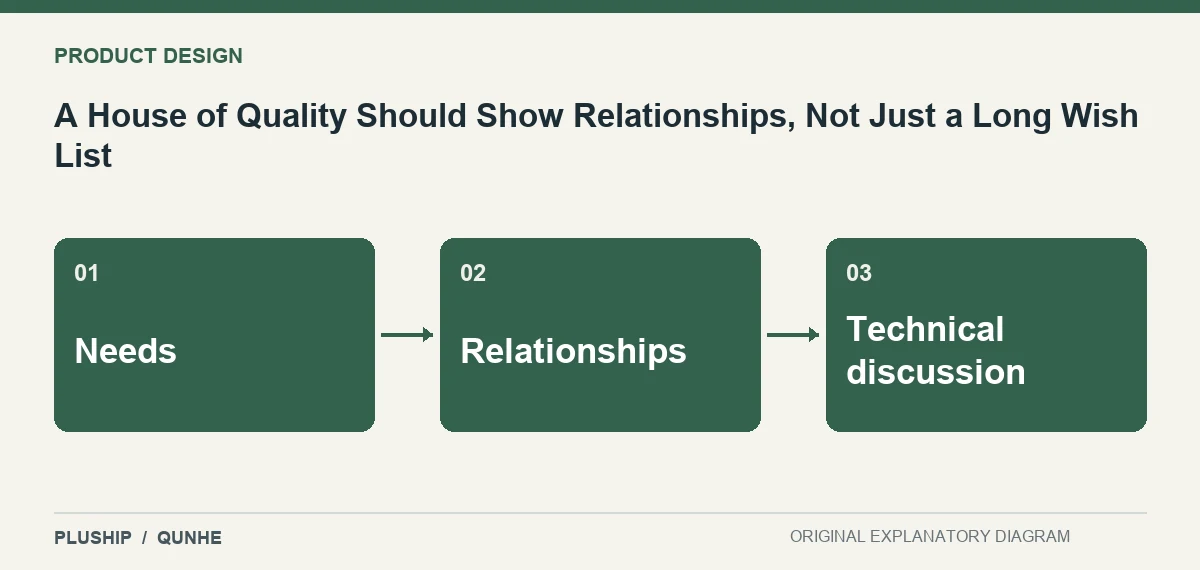
A table becomes useful when it explains how requirements relate. Filling every cell can make a design document look rigorous while hiding weak assumptions.
ASQ's House of Quality material presents a way to connect customer requirements with technical characteristics. ASQ — house of quality.
Define each row and column
For an illustrative product brief, keep the customer need and proposed characteristic understandable in ordinary language. Ask why a relationship is marked and what evidence supports it. Leave uncertain relationships open rather than assigning a score to complete the grid.
Review competing effects
One proposed characteristic may support one need while creating a problem elsewhere. Bring the relevant people into that discussion. Do not treat a calculated total as authority to ignore an unresolved safety, feasibility or rights question.
Keep the matrix with the decision rationale and sources. It should help the team explain a design choice, not conceal judgment behind an impressive-looking structure.
Source reviewed 25 October 2026. Practical interpretation and original illustrations by PLUSHIP / Qunhe; examples are illustrative.
Related reading
Packaging Volume Is a Design Variable, Not Just a Shipping Detail
A Light Source and an Illuminant Are Not Interchangeable Terms