
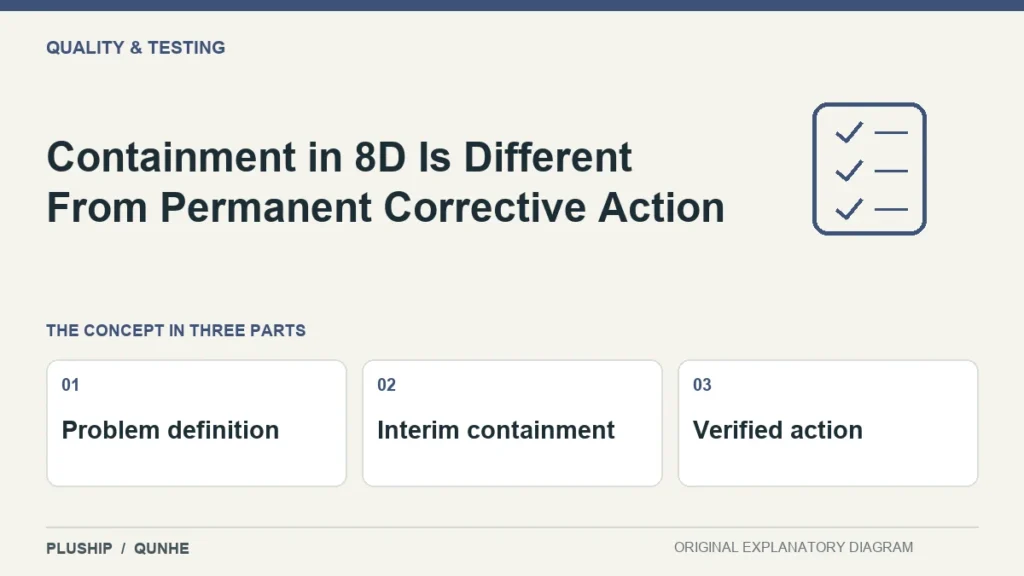
An urgent quality issue often needs an immediate response while its cause is still being investigated. Treating that response as permanent can leave the underlying condition in place.
ASQ's Eight Disciplines approach includes interim containment and subsequent corrective-action activities. ASQ — eight disciplines 8d.
State what containment covers
Identify the affected population, the temporary measure and the evidence supporting its scope. A response applied to one batch should not silently become assurance about all other production. Keep unresolved boundaries visible.

Verify the longer-term response
Use cause evidence to select corrective action and define how its effect will be checked. Decide when containment can be removed under the applicable process. A promise that the issue will not happen again is not a verification method.
The 8D structure is useful when it clarifies ownership and evidence. It should remain proportionate to the problem rather than becoming an eight-heading form filled with repeated statements.

Source reviewed 25 October 2026. Practical interpretation and original illustrations by PLUSHIP / Qunhe; examples are illustrative.
Related reading
Correction Fixes the Observed Problem; Corrective Action Addresses Its Cause
An A3 Report Should Show the Reasoning Behind the Action