
A list of things to inspect and a form for recording observations serve different purposes. Calling both a checklist can hide what the data collection actually needs.
ASQ describes a check sheet as a structured tool for collecting and analysing data. ASQ — check sheet.
Design around the question
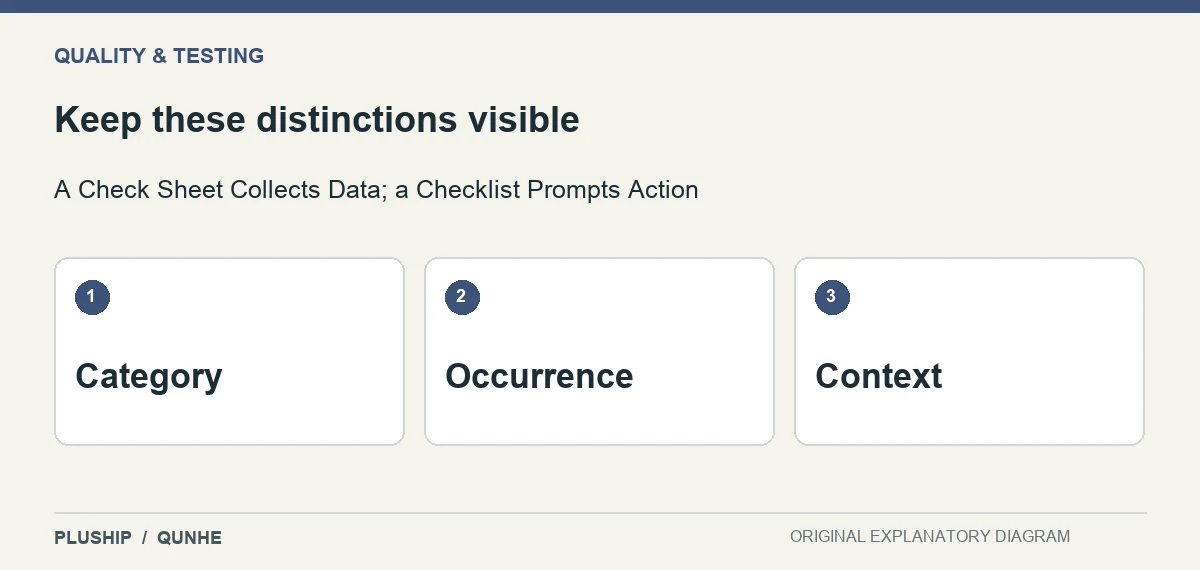
If the team wants to know which defects occurred, provide clear categories, a counting rule and the relevant production context. A tick showing that inspection happened does not provide the same information as a count of observed defects.

Trial the form
Ask two reviewers to use the proposed definitions on the same examples. If their records differ, clarify the categories before collecting a larger dataset. Preserve an option for an observation that does not fit, rather than forcing every finding into a misleading label.
A useful form makes the subsequent analysis possible. It should be simple enough to use at the point of observation and specific enough that another person can interpret the record later.
Source reviewed 25 October 2026. Practical interpretation and original illustrations by PLUSHIP / Qunhe; examples are illustrative.
Related reading
Containment in 8D Is Different From Permanent Corrective Action
Check Process Stability Before Interpreting Capability