
Running a set of trials is not enough to make the results interpretable. Plan how repeated observations and trial order will be handled before the first setting is changed.
ASQ describes design of experiments as a systematic approach to studying factors that affect a process or output. ASQ — design of experiments.
Define the response first
State what will be observed and how it will be measured. Select factors and feasible conditions with the responsible technical team. Do not treat an arbitrary set of trials as a designed experiment merely because several settings were changed.
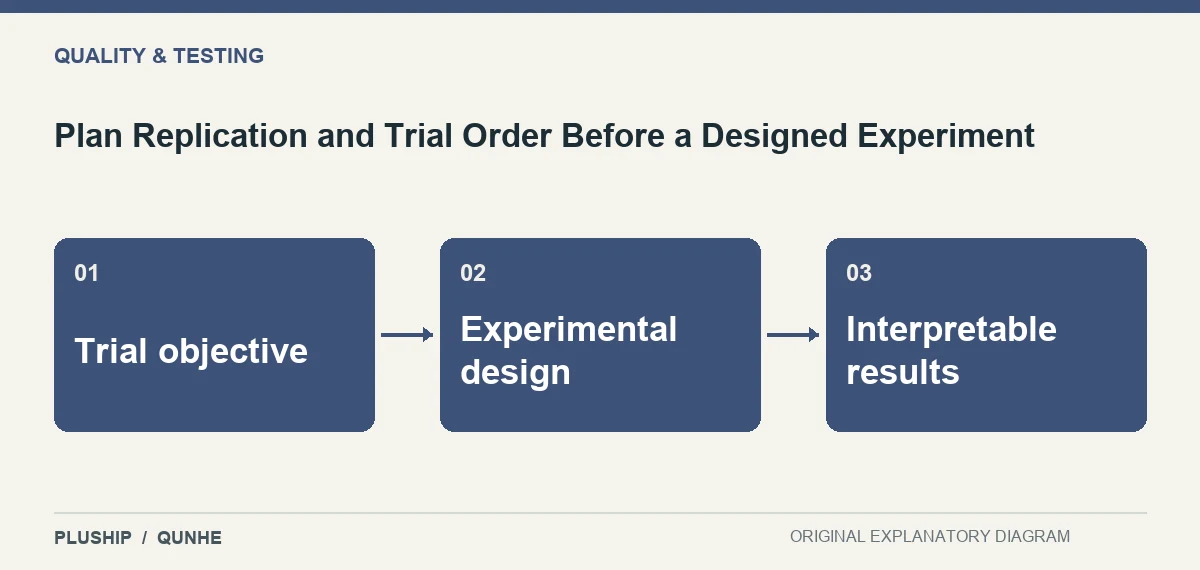
Plan the interpretation
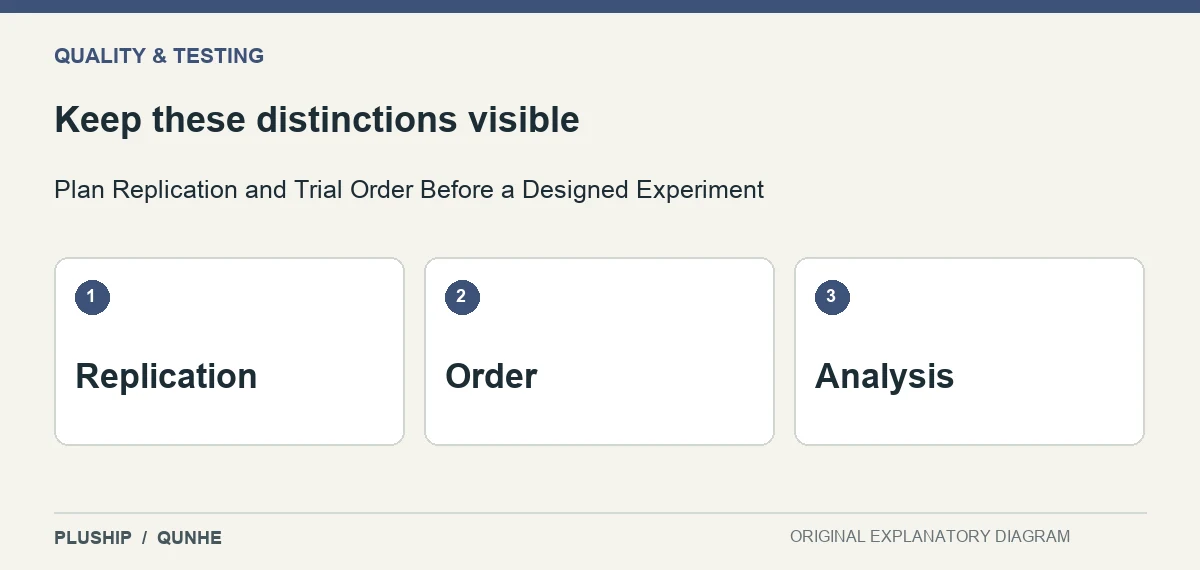
Ask the analyst how replication, randomisation and other relevant design choices address variability and confounding. Repeated readings of one specimen are not automatically independent experimental runs. Record deviations from the plan so their effect can be assessed rather than hidden.
For a soft-product process, the measurement method and practical trial constraints deserve early attention. A smaller well-designed study may be more informative than many uncontrolled samples with incomplete records.
Source reviewed 25 October 2026. Practical interpretation and original illustrations by PLUSHIP / Qunhe; examples are illustrative.
Related reading
A Histogram Hides the Order in Which Measurements Occurred
Check Process Stability Before Interpreting Capability
Customer Complaints Need Context Before They Become Improvement Data