

A measure can be easy to collect and still answer the wrong question. Decide what the project needs to learn before selecting the indicator.
IDEO.org describes indicators as defining the information collected to understand impact over time. IDEO.org Design Kit — Define Your Indicators.
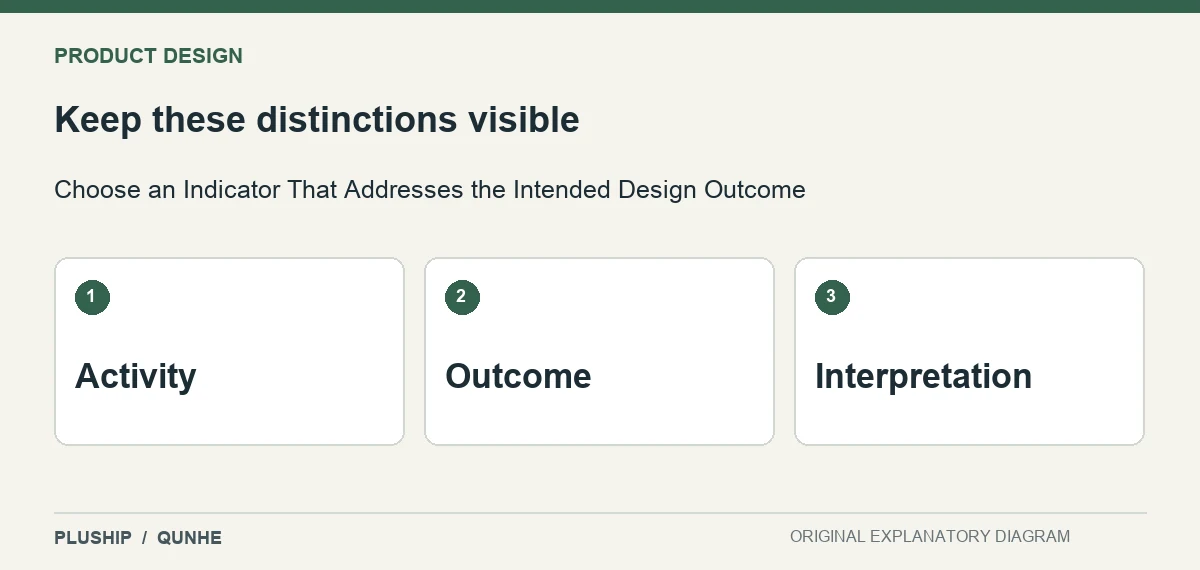
Separate activity and outcome
For a cultural-character display, counting distributed items differs from understanding whether visitors recognised the story. Identify the proposed link and what observation would support it.

Define interpretation in advance
State how the indicator will be collected and what its limits are. Avoid treating a convenient count as a direct measure of a different result. Keep missing evidence visible and review whether the method remains appropriate as the concept changes.
Source reviewed 25 October 2026. Interpretation and original diagrams: PLUSHIP / Qunhe. Examples are illustrative.
Related reading
A Design Roadmap Should Show Decisions That Depend on Earlier Evidence
Map Who Can Influence a Character-Design Decision