

A design review can ask how a product might fail before a failure appears in a finished sample. That changes the conversation from reacting to defects to examining the proposal.
ASQ describes FMEA as a systematic approach to identifying and prioritising potential failures and their effects. ASQ — fmea.
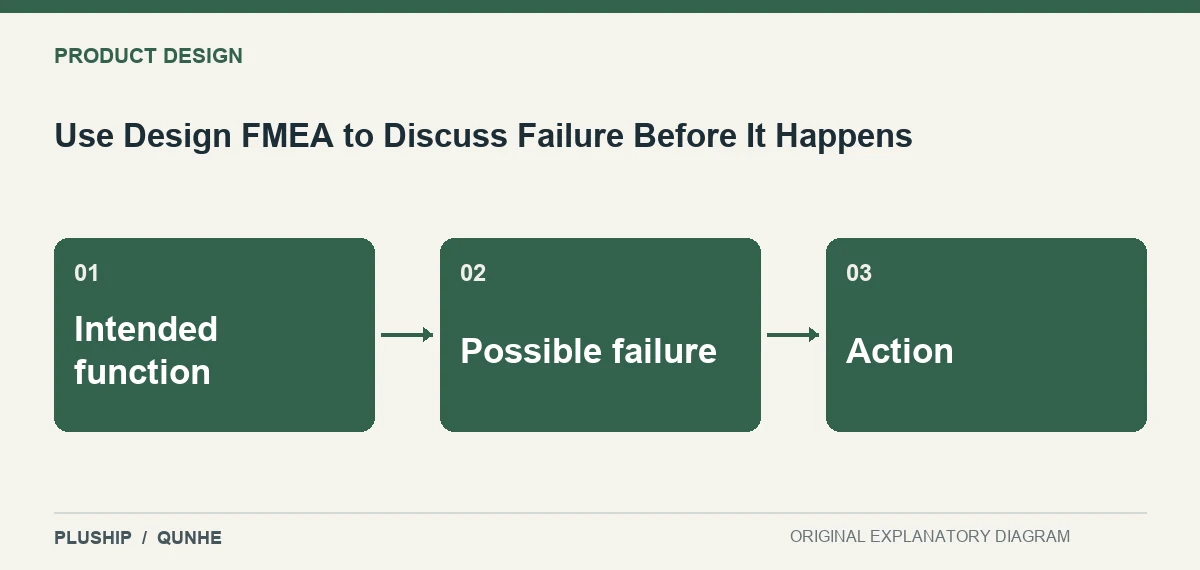
Start with a defined function
For an illustrative sewn product, describe what a part is intended to do, then discuss possible ways it could fail to do it. Keep the effect on use separate from the suspected cause. Do not assume the first explanation is proven.
Connect the review to an action
Identify which evidence, design change or further assessment is needed and who will review it. A completed form is not the same as an implemented and verified improvement. Keep any applicable product requirements in the discussion.
Use the exercise early enough that alternatives remain available. It supports a more informed design decision without certifying the product or replacing the testing and review needed for the actual project.

Source reviewed 25 October 2026. Practical interpretation and original illustrations by PLUSHIP / Qunhe; examples are illustrative.
Related reading
Observe the Use Context Before Expanding the Feature List
Ask How a Soft Product Comes Apart Before Calling It Circular
Two Design Factors Can Interact, So Test the Combination You Intend to Use