

A single accuracy figure does not show whether a classifier repeatedly confuses two materials. A confusion matrix makes those category relationships visible.
Scikit-learn describes confusion matrices as counts comparing true and predicted classes. Scikit-learn — model evaluation.
Read the labels first
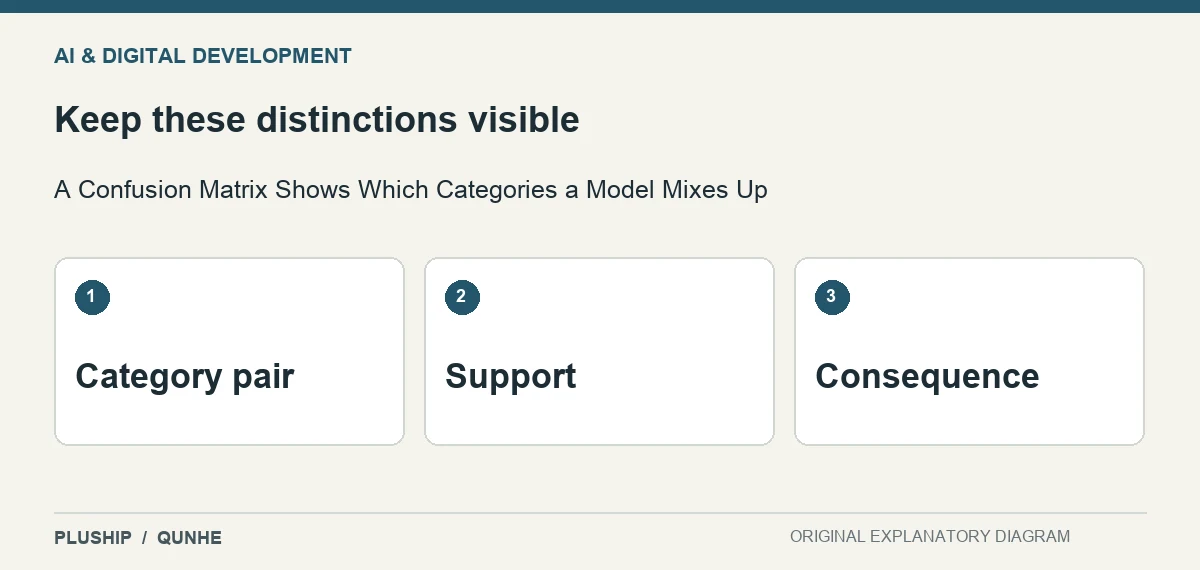
Confirm row and column meanings and whether values are counts or normalised proportions. Keep category names and sample support available. Otherwise, a small class can look prominent or disappear depending on presentation.
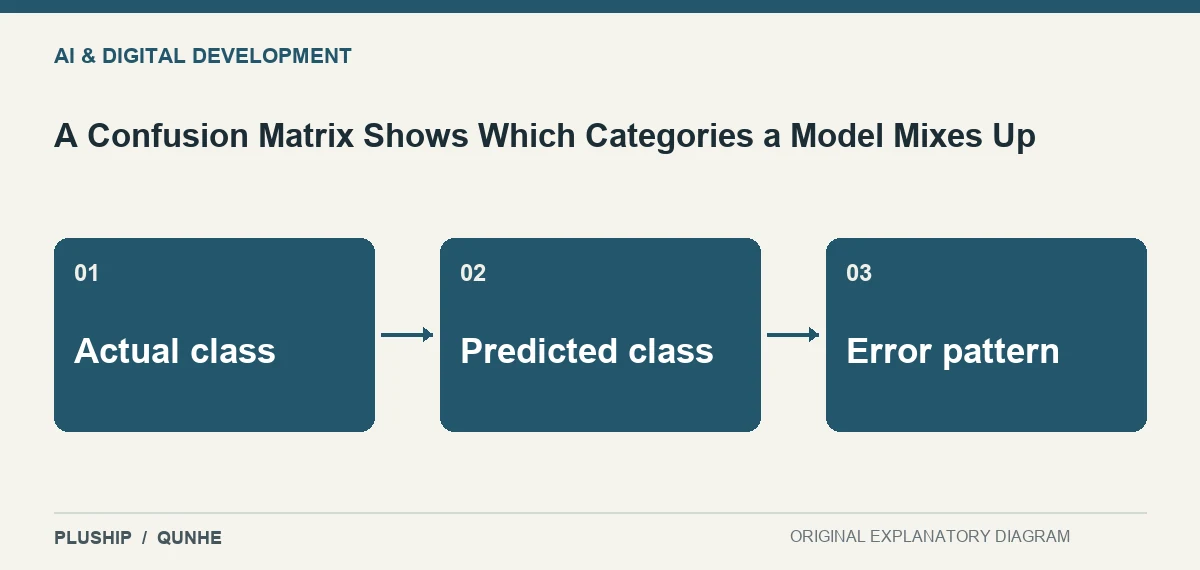
Investigate the pair
For a material-photo classifier, inspect the actual examples behind a repeated confusion. The problem may involve annotation ambiguity, visual similarity or unsuitable data. Do not turn the matrix into an automatic material identification claim without evaluating the intended operating conditions.
Source reviewed 25 October 2026. Interpretation and original diagrams: PLUSHIP / Qunhe. Examples are illustrative.
Related reading
Feature Selection Changes Which Inputs a Model Can Use
A Pipeline Keeps Learned Preprocessing With the Model