
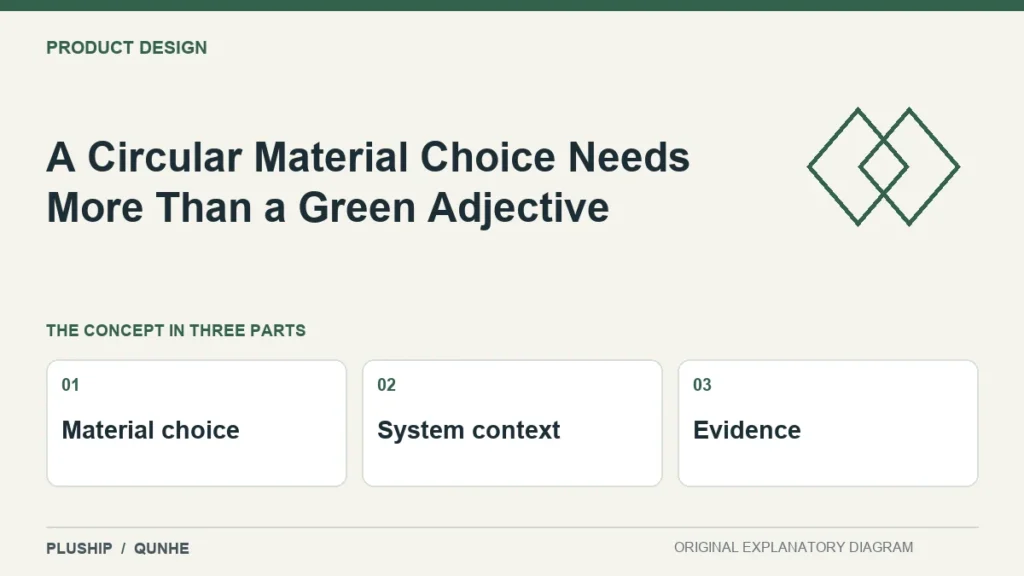
A material can have an appealing environmental description while leaving important product and end-of-use questions unresolved. Make those questions part of the design discussion.
The Ellen MacArthur Foundation's material-selection guidance connects material choices with safe and circular design considerations. Material selection.
Describe the actual proposal
Identify the material reference and the claim being considered. Ask what evidence supports it and which parts of the product it covers. Do not infer that a complete toy is recyclable or environmentally preferable from one component's description.

Look beyond procurement
Consider the intended use, construction and possible next life. A choice that looks simple in a purchasing table may create a difficult mixture to separate later. Treat that as a design question to investigate, not a conclusion that can be reached from a supplier slogan.
The next brief should identify evidence needs and trade-offs clearly. It should not turn a general circular-design aim into an unsupported certification or a quantified environmental benefit.

Source reviewed 25 October 2026. Practical interpretation and original illustrations by PLUSHIP / Qunhe; examples are illustrative.
Related reading
A Material Trial Needs an Identifiable Baseline
Circular Design Starts Beyond the Individual Material