
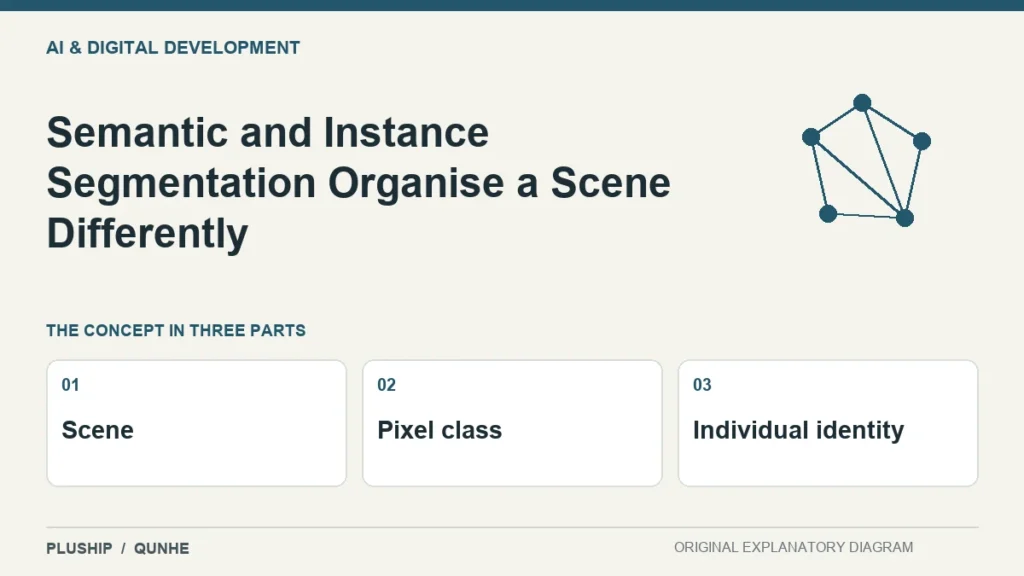
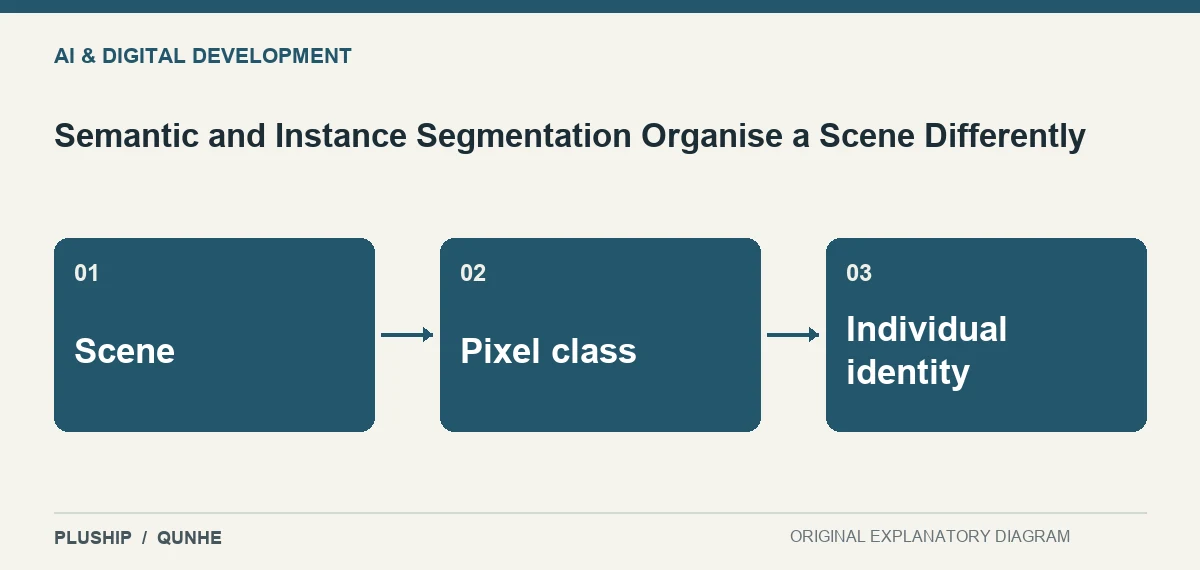
A table covered with fabric pieces can be analysed as material regions or as separate pieces. Those are different tasks, even when both outputs look like coloured masks.
Ultralytics distinguishes pixel-level semantic classes from segmentation that identifies individual object instances. Ultralytics — tasks.
Choose the required answer
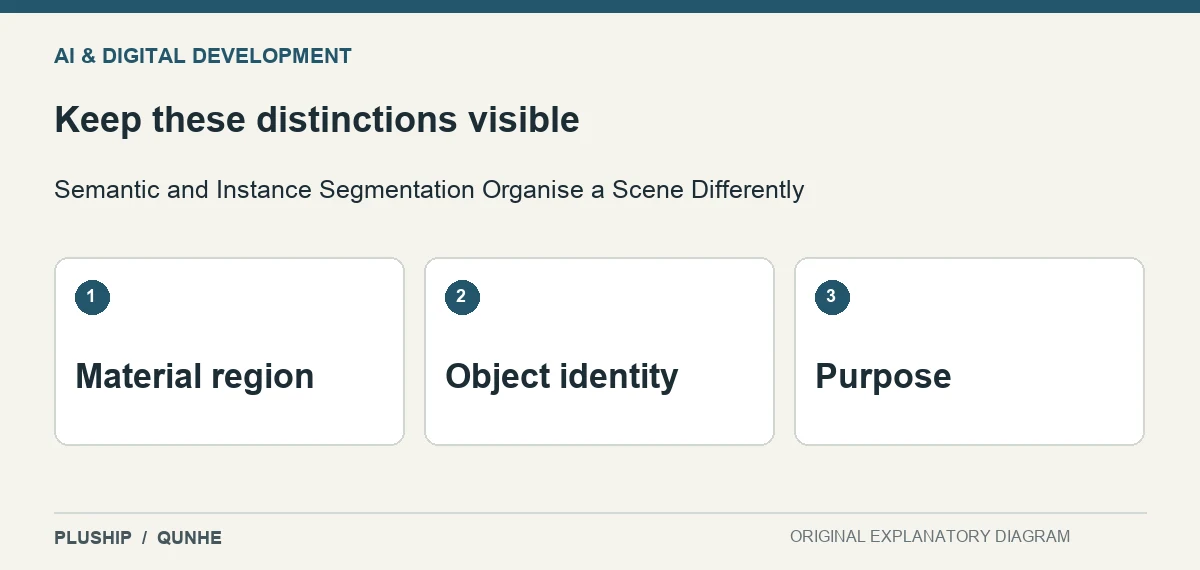
If the question concerns the region occupied by a material class, semantic segmentation may fit. If the question concerns separate pieces, the instance distinction matters. State the desired output before commissioning annotations.
Evaluate the difficult cases
Touching pieces and overlapping edges reveal whether the chosen representation answers the question. Do not infer an accurate piece count from a class-colour map that never represented individual identity. The data format must preserve the information the decision requires.
Source reviewed 25 October 2026. Interpretation and original diagrams: PLUSHIP / Qunhe. Examples are illustrative.
Related reading
Instance Masks Separate Individual Objects in a Product Photograph
Macro and Micro Averages Weight Category Performance Differently
Object Detection Can Locate a Detail Without Measuring Its Quality