

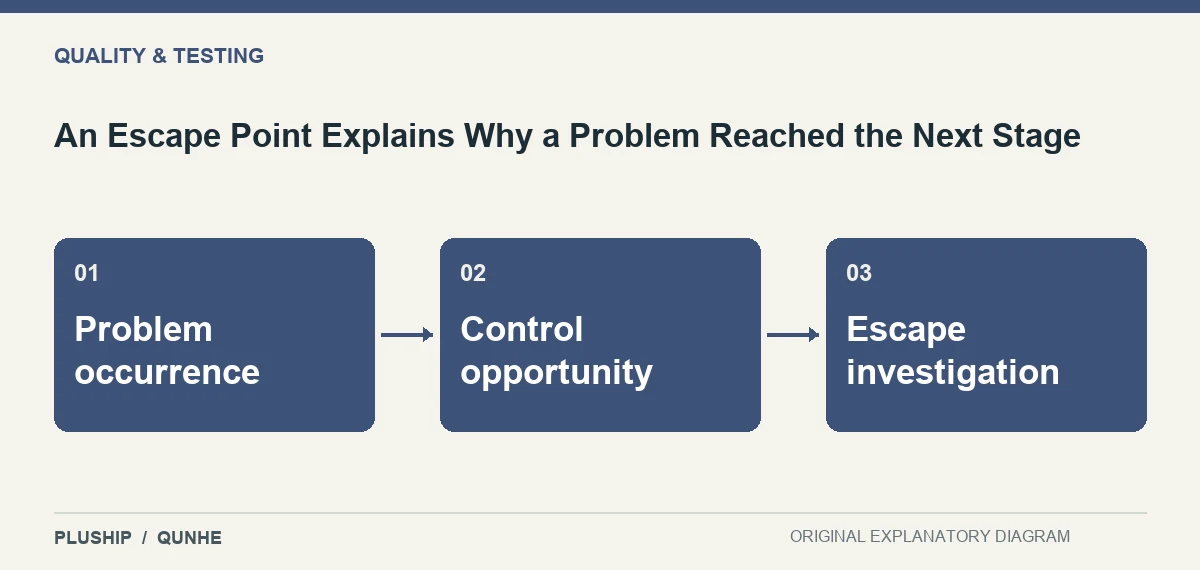
An investigation can explain why an issue occurred while leaving unanswered why the existing controls did not stop it. Those are different questions in the improvement work.
ASQ's 8D guidance includes identifying and verifying causes within a structured corrective-action process. ASQ — eight disciplines 8d.
Reconstruct the control path
For a production issue, identify where the relevant condition could have been detected under the actual plan. Review the evidence rather than assuming that another inspection would necessarily have found it.
Address both questions
A process change may reduce occurrence, while a control change may address the escape route. Verify the relevant effects separately. Avoid closing the entire investigation merely because the immediate affected items have been corrected.

Source reviewed 25 October 2026. Interpretation and original diagrams: PLUSHIP / Qunhe. Examples are illustrative.
Related reading
Metrological Traceability Belongs to a Measurement Result
Calibration, Adjustment and Verification Describe Different Work
Displayed Resolution Is Not the Complete Measurement Uncertainty