

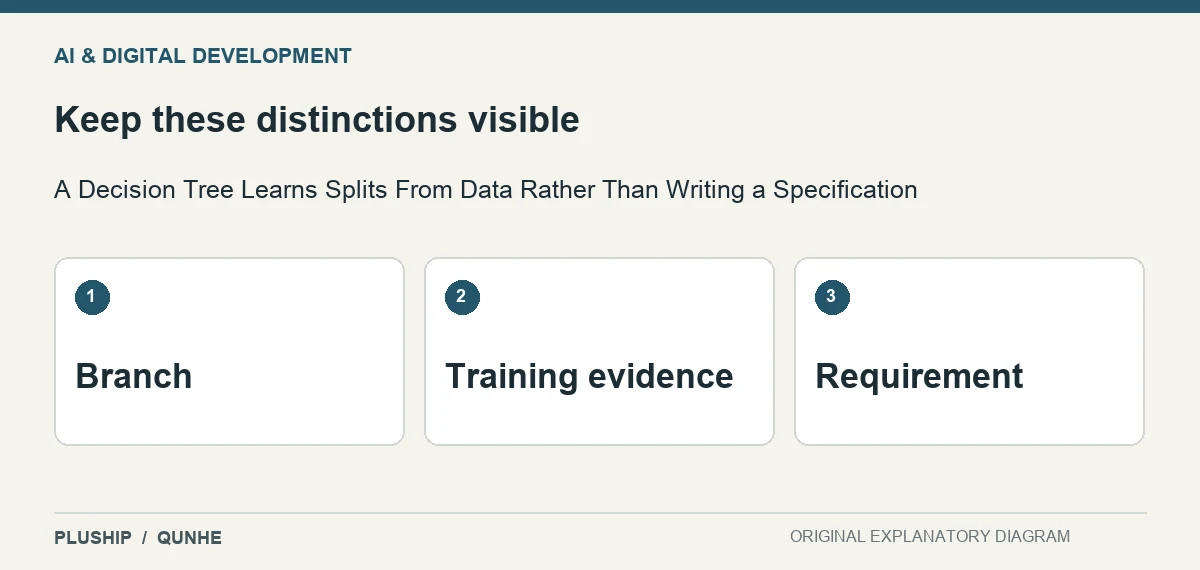
A readable tree can make a model's decisions easier to inspect. Its branches still describe learned predictive behaviour, not automatically approved production requirements.
Scikit-learn describes decision trees as models that learn decision rules from input features. Scikit-learn — tree.
Review the inputs
For a quality-record model, a split may reflect how historical data was collected. Investigate unexpected branches and fields that would not be available at the decision point. Readability alone does not remove data problems.

Protect the requirement boundary
Do not turn a learned threshold into a material tolerance without the appropriate technical basis. Evaluate the tree on suitable unseen data and review practical errors. A simple model can be useful precisely because its limitations are easier to discuss.
Source reviewed 25 October 2026. Interpretation and original diagrams: PLUSHIP / Qunhe. Examples are illustrative.
Related reading
Stratification Preserves a Chosen Class Mix in Data Splits
A Learning Curve Can Inform the Next AI Data-Collection Decision
A Product Can Need Several Labels Rather Than One Winning Class